Future of Museums
Overview
Scenario Planning is a set of methods used by some organizations to make flexible, long-term plans and prepare. With origins in military intelligence, and famously used by Royal Dutch Shell for strategic planning, scenario planning lends foresight and intution for plausible futures. As part of a class taught by Robert Fee at SCAD, Design Trends: Futures, Foresights, and Intuition was a thorough introduction to future-proofing strategic design.
The Problems (or Dilemmas)
The future can be a scary, volatile place when so many unknown agents and disruptors can influence the fragile systems we’ve created. Root problems lay in perceptions of a museum’s value–now and into the future. What happens when people prefer to watch a sensationalized movie about WWII or Alexander The Great, instead of seeing the artifacts in a museum? How might the proliferation of augmented and virtual reality affect museums’ visits and exhibits? How will the circular economy affect philanthropy and donations?
Process
Inspired by the authors and practitioners of modern scenario planning, we devised a hybrid project planning model that intertwined elements of the double-diamond with Peter Schwartz’s “scenaric” and Thomas Chermack’s “performance-based” approaches to scenario planning. The Delphi Method was also entertained, but with limited time and scope, distributing a bunch of surveys to experts would have introduced some complexity that we couldn’t manage.
Discovery
During discovery we identified and engaged multiple museum directors and docents in Savannah, GA. Through a series of empathy interviews among four local museums, we were able to highlight key questions they have about their future. Their planning ranged from one to three years, and revealed a number of variables we needed to examine. When asking about five, ten, and 20 years in the future, they thought it was too far to know–but would be helpful to have some hints. With these directors and docents as stakeholders, we mutually agreed that those would be the periods for scenarios to-be.
As a team, we wanted to know:
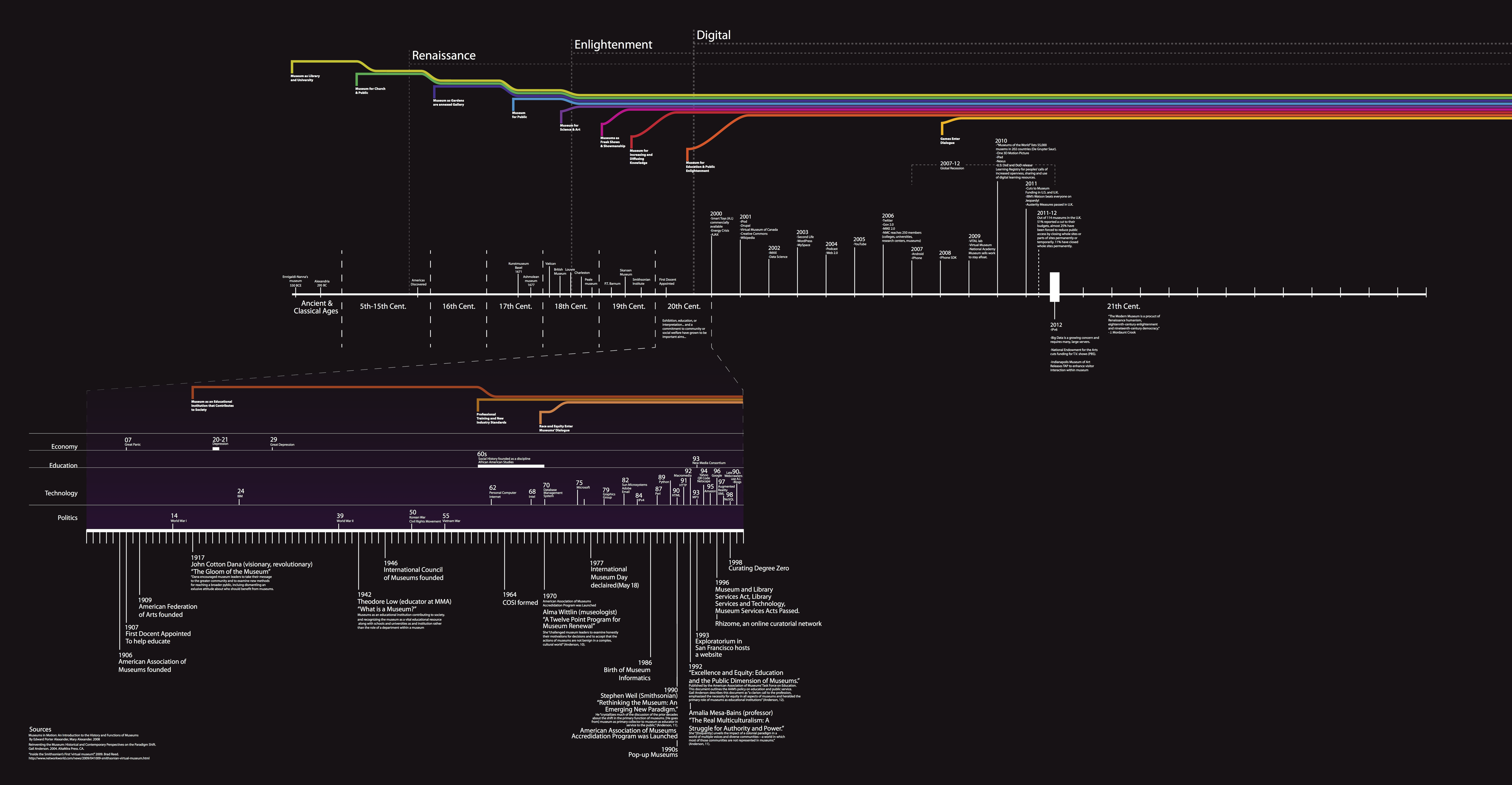
- How museums evolved in their definitions and uses against the backdrop of various environments. We sifted through all the literature we could find on the history of museums and began plotting a timeline.
- The emerging technologies that will one day be vehicles for novel communication
Analysis
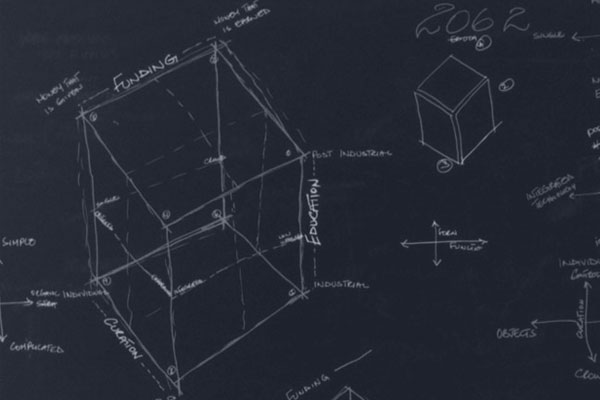
Combining our interview data with desk research, a number of themes came to light. We began to plot axes of uncertainty, with trajectories to possible futures. When stepping back to see our war wall, it was clear that a few interrelated forces influence eachother to create conditions driving museums to change and adapt their services. These categories for the matrices related to the purposes of museums:
- Education for Continuation of Artifacts and Culture
- Funding for Maintenance of Artifacts and Programs
- Curation of Artifacts for Accuracy and Continuation
Note: a fourth was entertained for a long time, too. War. During wars, museums are ransacked and destroyed–their artifacts scattered to the wind on black markets. Since stakeholders were in the continental United States, we chose to purpose that scenario for cases of importing artifacts.
Synthesis
The concerns stakeholders had about their museums one and three years ahead gave us a glimpse of the systems influencing their decisions. These formed the basis of key questions that we carried into development of ten mini scenarios. Honing in on the top scenarios was a matter of ranking through careful deliberation. Among the criteria for selection were:
- Do the variables include content from key questions voiced by stakeholders?
- Can actions be taken now or within the next few years to influence the scenarios as written?
- Are assumptions backed by plausibility and likelihood of cascading events (grounded in reasonable evidence)?
Development
We chose to keep humans at the center of our stories. Therefore, we developed main characters who went about their daily tasks in the future. It helped make the reading experience personable–and retained human-centered design as an integral part of scenario planning.

Delivery
As a team, we thought of how we might best deliver with impact. Handing off a bunch of papers and a booklet is a given. But papers just sit around and booklets collect dust. We knew the stakeholders would be more enticed to share our work if it were in attention-keeping formats. Our intent was not to replace the written scenarios; we wanted to augment them to build intrigue for reading.
Results
- Stakeholders from local museums applauded our team for painting a series of futures for which they could prepare.
- Fisher-Price learned of our scenario planning program and engaged us in a sponsored project about the future of toys (Robert Fee asked me to be a teaching assistant for that project).
Team & Roles
- Deaa Bateineh, Research and Graphics
- Nicholas Schroeder, Research and Animation
- Hina Shahid, Research and Coordination
- Kelly Lynn Carroll, Research and Diagramming